Every step. Every batch. Verified.
Peptides are fragile molecules. How they're synthesized, freeze-dried, shipped and reconstituted determines whether the mg on the label is the mg in the vial. This is the KINETYX protocol — nine steps from raw amino acids to a syringe on your bench.
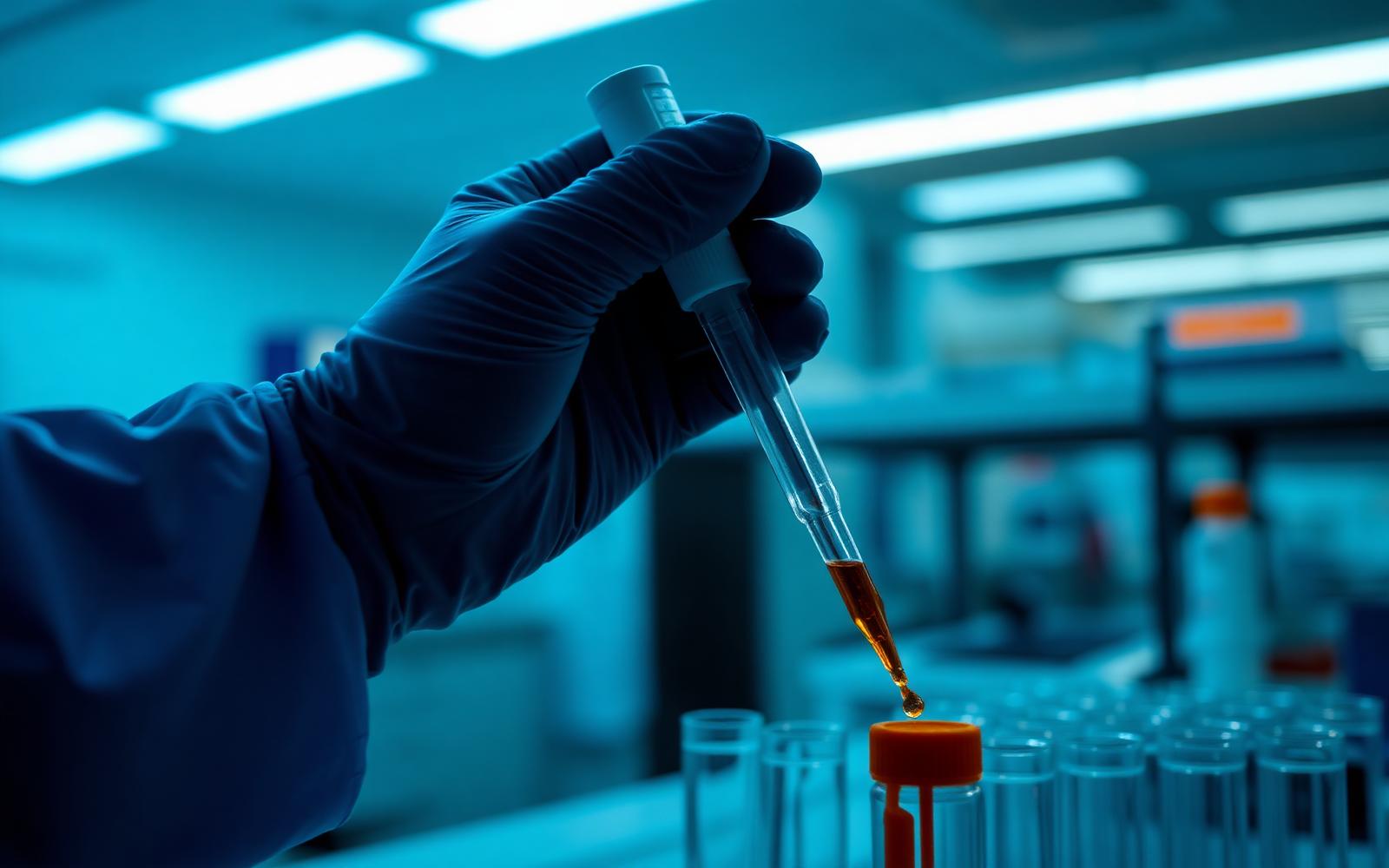
Where the amino acids come from.
Peptide quality is set upstream — at the amino acid supplier. KINETYX works exclusively with two audited manufacturing partners in the United States and the European Union, both operating under current Good Manufacturing Practice (cGMP). There are no white-labeled overseas resellers in our supply chain, and every raw amino acid arrives with a certificate of origin, an HPLC-verified identity report and a batch record we retain for seven years.
The reason is simple: unqualified sourcing is where heavy-metal contamination, incorrect stereochemistry and truncated sequences first enter the pipeline. Fixing them downstream is nearly impossible.
Solid-phase peptide synthesis (SPPS).
Every KINETYX peptide is built one amino acid at a time using Fmoc solid-phase peptide synthesis on Wang or Rink amide resin. Each coupling cycle is monitored with a Kaiser or chloranil test to confirm complete reaction before the next residue is added. Incomplete couplings are the primary source of "deletion sequence" impurities — peptides missing a single amino acid, which HPLC often struggles to separate from the target.
After the final coupling, the peptide is cleaved from the resin with a trifluoroacetic acid (TFA) cocktail tailored to the sequence, precipitated in cold diethyl ether, and moved to purification.
HPLC, mass spec, endotoxin.
Purity is measured, not claimed. Every KINETYX batch is analyzed by an ISO-17025 accredited third-party lab using three orthogonal methods:
- Reverse-phase HPLC — quantifies purity as an area-percent of total UV-absorbing species at 220 nm. We reject any lot below 98.0%; most ship above 99.0%.
- Electrospray mass spectrometry (ESI-MS) — confirms molecular weight matches the theoretical sequence within ±1 Da.
- LAL endotoxin assay — verifies bacterial endotoxin load is below 0.25 EU/mg, the threshold for parenteral research material.
The full Certificate of Analysis for every lot is published on our lab results page. Search by lot number printed on the vial.
Why peptides ship as a freeze-dried powder.
Peptides in aqueous solution degrade quickly — proteolytic fragments, oxidized methionines and deamidated asparagines accumulate within days at room temperature. To stop the clock, we lyophilize (freeze-dry) every peptide immediately after purification.
The process: purified peptide is dissolved in water with a bulking agent (typically mannitol), flash-frozen to −45 °C, and placed under deep vacuum. Ice sublimates directly to vapor over 36–72 hours, leaving a dry, amorphous white cake with residual moisture below 2%.
The result is the fluffy white puck you see at the bottom of a KINETYX vial. In this state, most peptides are stable at 2–8 °C for 24+ months and at −20 °C for years. Reconstitution is the moment the clock restarts — which is why dosing math matters (see below).
From freezer to your door.
Lyophilized peptides are more forgiving than solutions, but heat excursions above 30 °C still accelerate degradation. Every KINETYX order ships in an insulated mailer with phase-change coolant panels pre-conditioned to 4 °C. Transit is capped at 48 hours via priority carriers, and orders placed after 2 PM local time on Thursday hold until Monday to avoid weekend warehouse dwell.
A temperature logger is included in orders above $500 on request — free of charge, returnable for a data readout.
How to bring the powder into solution.
Bacteriostatic water (BAC water) — sterile water with 0.9% benzyl alcohol as a preservative — is the standard solvent. The benzyl alcohol suppresses microbial growth for 28 days once the vial is punctured, which matches typical dosing timelines.
- Let the vial warm to room temperature (10–15 minutes).
- Swab both stoppers (BAC water and peptide) with a 70% isopropyl alcohol pad.
- Draw your chosen volume of BAC water into an insulin syringe — common choices are 1 mL, 2 mL or 3 mL depending on how many doses you want per vial.
- Slowly inject the BAC water down the side wall of the peptide vial. Never inject directly onto the powder cake — high shear can denature the peptide.
- Gently swirl (do not shake) until the powder fully dissolves. Store the reconstituted vial refrigerated at 2–8 °C.
mg, mcg, IU and syringe units.
Dosing peptides is arithmetic, not intuition. Three numbers matter: the vial size (mg of peptide), the reconstitution volume (mL of BAC water added), and the target dose (mcg per administration).
The formula:
concentration (mcg/mL) = (vial mg × 1000) ÷ BAC water mL
syringe units           = (target mcg ÷ concentration) × 100
A U-100 insulin syringe is graduated in units, where 100 units = 1 mL. That's the "× 100" in the second line.
A 5 mg vial of BPC-157 reconstituted with 2 mL BAC water yields 2,500 mcg/mL. To dose 250 mcg, you draw 10 units on a U-100 insulin syringe (0.10 mL). The vial contains 20 doses.
Every KINETYX product page ships with an interactive reconstitution calculator so you don't have to do the math manually — but knowing the math is what keeps you safe when the calculator isn't there.
Before and after reconstitution.
- Refrigerated 2–8 °C — 24 months
- Frozen −20 °C — 36+ months
- Room temp <25 °C — up to 30 days in transit
- Refrigerated 2–8 °C — 28 days
- Never freeze a reconstituted vial (crystals shear peptide bonds)
- Protect from light — amber wrap or original box
What KINETYX is, and isn't.
KINETYX peptides are sold as reference-grade research chemicals. They are not approved drugs, are not intended for human consumption, and are not reviewed by the FDA for safety or efficacy. Nothing on this site constitutes medical advice.
We publish every Certificate of Analysis, disclose our synthesis partners under NDA on request from qualified institutional buyers, and maintain a batch traceability record for seven years. If you are a licensed clinician, researcher or compounding pharmacist and need documentation we haven't published, email lab@kinetyx.com.